

LAND STRATEGY | DEVELOPMENT INTELLIGENCE | ARBITRAGE
HOLD OUT ARBITRAGE
Why defend what you have when you can engineer what they need.
ASSET TYPE
Land
LOCATION
Midtown, Manhattan
APPROACH
RLV Arbitrage, Development Re-Design
OUTCOME
Deal closed at modeled value
$466M
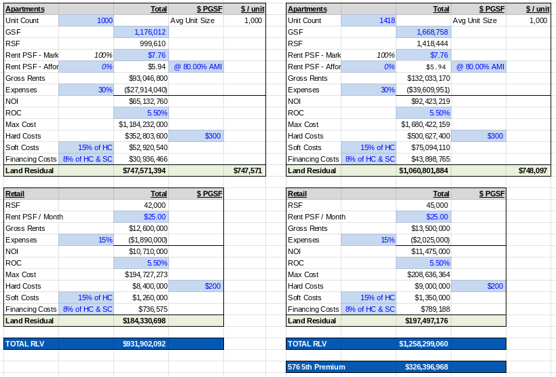
Net value of the offer scenario engineered for the opposing developer
$326M
Residual land value premium in the optimal development scenario
3
Macro strategic pathways fully modeled with complete RLV analysis
18+
Years of assemblage activity analyzed. The leverage was larger than anyone knew.
ABSTRACT: MOST PEOPLE IN THIS POSITION HIRE A LAWYER. WE BROUGHT A PENCIL.
The conventional holdout strategy asks: how do we defend what we have? The arbitrage question asks: how do we engineer what they need? These are not the same question and they do not produce the same outcome.
A single parcel surrounded by 18 years of active assemblage presented what appeared to be a defensive position. We reframed it as an offensive one. Rather than modeling the value of resistance, we modeled the full development - better than the plan already in motion and calculated the precise gap between the existing scheme and the optimized one.
That gap became the value of the parcel. Not what the holdout was worth in isolation. What it was worth to the development with it included versus without it.
Three macro strategies were built with complete RLV modeling: Proceed, Participate, and Parlay. The Parlay pathway produced a $326M residual land value premium in the supertall scenario. The recommended path (Parlay A into Parlay B) preserved optionality across all timelines while generating the maximum defensible number.
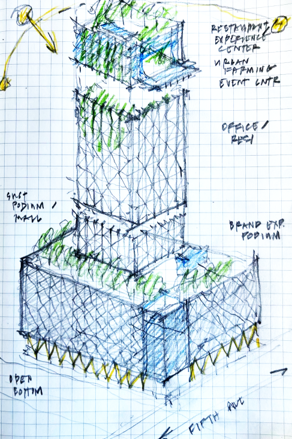
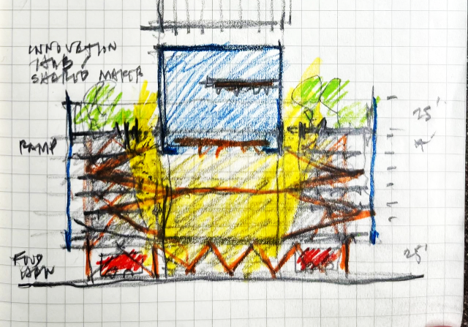
The building that went up looks like our sketch. The deal closed at the modeled value.
Why defend what you have when you can engineer what they need?